
Zane’s Law Campaign submits evidence to the Environmental Audit Committee’s Air Pollution Inquiry (API) with full backing from the TUC
17 March 2026
The Zane’s Law Campaign, together with other contaminated land campaigns united under the the UK Landfills Campaign umbrella, have all submitted evidence to the API, making the case that there can be no clean air without clean land, and that the Clean Air (Human Rights) Bill and the Zane’s Law (Clean Land (Human Right) Bill should work in tandem to properly address the ‘Human Right to a Clean, Healthy and Sustainable Environment’, as enshrined in the historic United Nations Resolution passed in July 2022.
The TUC have given their full backing to the Zane’s Law Campaign submission and are working with us to progress work on the proposed legislation. The Inquiry is currently underway. See more here: Air Pollution in England – Committees – UK Parliament
Support for Zane’s Law – the Clean Land (Human Rights) Bill is growing
17 March 2026
On the anniversary of what would have been Zane Gbangbola’s 19th birthday – 21.10.2025 – Andy Burnham, Mayor of Manchester and Steve Rotheran, Mayor of Liverpool, both publicly backed Zane’s Law.
Since then, through November 2025, three further Local Authorities have also backed Zane’s Law:
- On 12 November – Havering Council Cabinet – unanimously
- On 26 November – Bolton Council – unanimous cross-party support
- On 28 November – Barking & Dagenham Council – unanimous cross-party support
This brings the number of Local Authorities who have so far backed Zane’s Law to 12.
Newham Borough Council unanimously vote to back Zane’s Law
17 July 2025
Newham Borough Council unanimously vote to back Zane’s Law calling for tighter regulation and oversight of contaminated landfill sites and polluted waters. Leaders and Members warmly applauded Zane’s parents and those dedicated to protecting communities at risk.
Mayor backs contaminated land law in child’s name
17 July 2025
The mayor of London Sir Sadiq Khan has pledged his support for a proposed new law to ensure greater transparency over contaminated land.
Zane’s Law is named after seven-year-old Zane Gbangbola, whose parents say was killed by gas from landfill when the River Thames flooded their home in Chertsey, Surrey, in 2014.
Proposed measures include requiring councils to keep public registers of contaminated sites.
A spokesperson for the Truth About Zane campaign said: “The mayor’s support signals growing momentum for legislative change, and increasing recognition of Zane’s family’s decade-long campaign.” A statement from the Mayor of London’s office said: “The Mayor supports the London Assembly’s motion in favour of Zane’s Law.
“He shares the Assembly’s concerns over impacts on Londoners, and the potential for land which may be contaminated not to be identified as such, particularly given the responsibility sits between the local authorities and the Environment Agency.
“He is also concerned that there are inadequate resources available for regulatory authorities to properly address the issue.”
Zane’s Law would ensure that all potentially contaminated land is identified, made public, regularly inspected and properly cleaned up.

It would mean local authorities would be given the funding, resources and powers to act. Kye Gbangbola, Zane’s father, was paralysed in the same incident that killed his son. He met the mayor at the London Assembly on Friday to discuss the proposed new Law. Sir Sadiq told Mr Gbangbola how “sorry” he was for the “tragic loss” of his son’s life.
Implementing Zane’s Law was adopted as Green Party policy in September. A motion supporting the proposed law was unanimously accepted by the London Assembly in November.
Zack Polanski, Green London Assembly member, who has championed the cause within City Hall, said: “The mayor has made an important step in backing Zane’s Law, but there’s still so much more that can be done.
“He should use his influence to urge the government to bring in this law and ensure its full support and implementation.”
An inquest into Zane’s death concluded he was killed by carbon monoxide from a petrol pump used to clear floodwater from his home in Thameside, but Mr Gbangbola and Ms Lawler say the pump was not used.
They have accessed public health documents that stated firefighters found hydrogen cyanide in their home, but no carbon monoxide.
Lewes District Council was the first to support the law in February 2024, followed by several others including Brighton & Hove City Council and Adur District Council.
Original Article by Stuart Maisner – BBC News, South East
Zane’s Law Summit at Westminster: “Make toxic landfills safe!”
14 June 2025
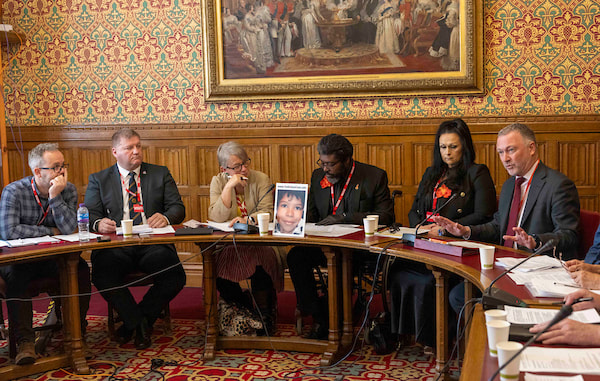
Campaigners calling for ‘Zane’s Law’, to protect communities from contaminated land, held a summit at the Houses of Parliament on the 11 June.
The proposed law would improve transparency around historic landfill sites and clarify who is responsible for making these safe. It is named after seven-year-old Zane Gbangbola, who died on 8 February 2014 when floodwater passed through landfill into the basement of his family’s home in Chertsey. His father, Kye Gbangbola, was left paralysed by the same incident.

Surrey Fire and Rescue Services detected high levels of hydrogen cyanide in Zane’s home. The landfill site has still not been properly tested, despite the discovery of a 2010 report warning of an “unacceptable risk” of migrating landfill gasses from the site causing “significant harm, serious injury and capable of causing death”.
Campaigners from more than twenty communities experiencing severe and sometimes fatal harms from toxic landfill and contaminated water spoke at the event, supported by the FBU and Baroness Natalie Bennett.
Speakers also included Des Collins, the solicitor who represented families affected by the toxic waste scandal in Corby, as dramatised in the recent Netflix series Toxic Town.
Zane’s parents, Kye and Nicole Gbangbola, continue to call for government action, saying that “Britain should be leading the way in environmental law. Instead our legislation is woefully inadequate.”
Baroness Natalie Bennett, who will chair the hybrid meeting, said:
Current UK regulations on contaminated land are grossly inadequate and a threat to the safety of many, especially given climate breakdown, rising sea levels, increased rainfall, and flooding. Zane’s Law proposes measures to address this crisis. The need to act was acknowledged in the 1990 Environment Protection Act, but then the protective provisions were removed after lobbying of the Conservative government by mass house builders. I hope, but sadly don’t expect, that Sir Keir Starmer’s government would step up to one of its primary responsibilities, to protect life.”
Steve Wright, Fire Brigades Union general secretary said:
Contamination from unregulated, historic landfill poses a serious threat to the environment, health and lives. With the climate emergency resulting in increasing floods, which threaten to spread this contamination, the government cannot ignore the rising risk.
Everyone should have the right to live in a clean, healthy and sustainable environment. Firefighters, who are on the frontline of flooding incidents, stand with the communities who have been tragically impacted and with the continued call for justice for Zane.
The UK government must bring in Zane’s Law to save lives by properly regulating contaminated land and water.”
Zane’s parents, Kye and Nicole Gbangbola, said:
Today we’ll hear the brave voices of people who are struggling to get protection from the horrific impacts of living in proximity to toxic landfill and poisoned water – and hear them at the heart of government. Britain should be leading the way in environmental law, instead our legislation is woefully inadequate. We need Zane’s Law now!”
ORIGINAL ARTICLE >>
“His parents, Kye and Nicole, and Zane himself were harmed by hydrogen cyanide gas that leaked from a nearby flooded historic landfill and entered their home. Zane paid the ultimate price for this silent, buried danger — with his life.
Their fight for truth has ignited a nationwide campaign, as more and more victims of these polluting time bombs come to light.
“Nicole and Kye, your courage, persistence, and clarity — and Zane, your life — have brought these issues into the light…” said Douglas-Home, “…as opposed to the unbearable darkness of Zane’s untimely death.”
Over 100 potentially toxic former dump sites have flooded since 2000 – Zane’s Law Needed
26 April 2025
More than 100 old landfills across England containing potentially hazardous material have flooded at least once this century, according to analysis by Unearthed.
Historic landfills can contain dangerous substances such as heavy metals, persistent pollutants, pharmaceuticals and industrial waste. They often lack measures such as linings that limit the risks of these pollutants affecting the surrounding environment.
Unearthed also found over 2,600 former dump sites with potentially hazardous contents within 50m of watercourses across England.
As climate change threatens to make floods more frequent in Britain the risk of landfills leaching substances into watercourses goes up, scientists warn.
“We’ve been landfilling waste for hundreds of years, but we haven’t really considered the consequences of climate change on those historic landfills and the pollution they contain,” Professor Kate Spencer, an expert on historic landfills at Queen Mary University of London, told Unearthed.
“We now know far more about the potentially harmful effects of the waste materials and pollutants we’ve dumped, particularly chemicals like PFAS and PCBs, and how the impacts of climate change, such as flooding, could reopen pathways for those pollutants to enter the environment,” she added.
PFAS (per- and polyfluoroalkyl substances) are a group of thousands of man-made chemicals that are widely used in consumer products to make them heat resistant, non-stick or stain-repellant. Exposure to some of these chemicals has been associated with cancers and health complaints, including liver disease and decreased fertility.
PCBs (Polychlorinated Biphenyls) are man-made organic chemicals that were used in a variety of industrial processes, often for their flame-retardant properties. They have been phased out globally starting in the 1970s, with strict controls on their production and disposal, partly due to their links with cancer. They are among the substances known as “forever chemicals” because they take hundreds or even thousands of years to break down in the environment, meaning that even if they were dumped decades ago, they could still pose a risk to those who are exposed to them now.
There are almost 20,000 historic landfill sites across the country, but records of what these sites contain are patchy. There is no central record of whether former landfills have been officially designated as contaminated sites, as this happens at local authority level but scientists believe they could contain hidden dangers.
“Most of the 20,000-odd former landfill sites are likely to be quite safe and contain relatively inert waste, but some could be quite sinister,” Dr David Megson, a scientist at Manchester Metropolitan University who previously worked remediating old landfills, told Unearthed. “Historic reporting of what went into these sites wasn’t great, so in many cases, you’ve got little idea what is in there until you dig into it.”
Unearthed, working with Dr Paul Brindley at the University of Sheffield, overlaid Environment Agency (EA) flooding data onto the government’s map of historic landfills across England to identify sites that have flooded since the turn of the century.
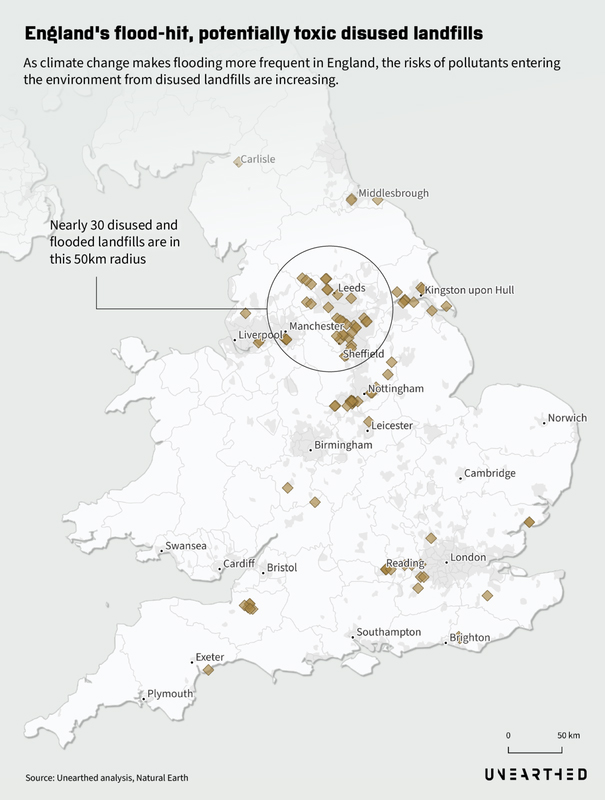
Using the government’s dataset, Unearthed identified landfills that had closed before rules came into force in the mid-1990s to protect the environment from pollution, and those which had had at least half of their surface area flooded. We removed any landfills that have been built on or otherwise concreted over. Within this subset, Unearthed looked for landfills marked as taking potentially harmful waste, including “commercial” and “industrial”, as well as “special”waste, which requires special disposal requirements due to its potential to pollute and “liquid sludge”, which comes from industrial processes.
The EA’s data does not record every flood event, while the historic landfills database only contains a partial record of what went into these former dump sites. Only 55% of sites in the historic landfills dataset record a “last input” date, showing when they stopped receiving waste. Owing to the patchy nature of both datasets, Unearthed’s figures are likely to be an underestimate.
Sites across the country
Historic landfills are dotted all over the country, but most people would have no idea they live near one. There are many public parks and nature reserves built on old landfills, and Unearthed identified instances where business parks and housing estates were built directly alongside or even overlapping former landfills with potentially hazardous contents that had flooded this century.
The Green party, along with councils including Brighton & Hove, have backed ‘Zane’s law’, which aims to update the UK’s rules on toxic waste disposal. The law is named after Zane Gbangbola, a Surrey seven-year-old who died in 2014. His family believe his death was caused by toxic chemicals that entered their home when a nearby disused landfill flooded.
Gbangbola’s family said that no environmental searches on their property had identified that the lake behind it was a former landfill site – this information only came to light after their son had died. Lavenders, the former landfill site, is not included in Unearthed’s analysis, as the historic landfills database does not record the types of waste it received or the date it closed.
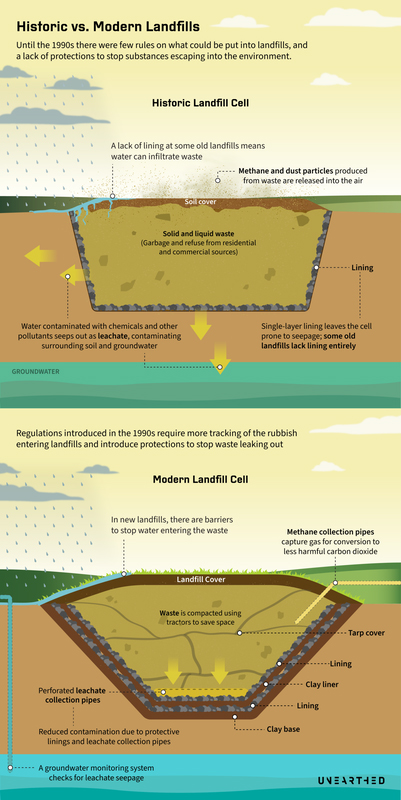
Zane’s law would impose a duty on councils to record potentially contaminated sites, and to investigate and, where necessary, remediate former landfill sites. It would also make central government responsible for covering the cost of these works.
Green party peer Natalie Bennett told Unearthed: “The lack of adequate regulations on contaminated land poses a threat to human life and welfare, especially given climate breakdown, rising sea levels, increased rainfall, and flooding.”
Zane’s law would align the UK with “global best practice for the protection of communities from hazardous land,” she added.
A ‘reactive approach’
Local authorities are required to keep a register of land that is known to be contaminated, and to inspect any sites that could be contaminated, but one expert said there has been an “erosion of funding” to do this work.
Councils used to be able to bid for money through the Contaminated Land Capital programme, which the EA administered, but this grant ended in 2017.
“Local authorities will be aware of problematic sites, but due to the lack of adequate funding, they have had to adopt a reactive approach,” explained Dr Grant Richardson, an environmental consultant specialising in landfills and contaminated land.
“If there’s no obvious risk of harm or pollution emanating from these sites, nothing will be done to investigate or remediate them unless sites come to be developed,” he added. “That means there are likely hundreds or potentially thousands of sites that have not been properly investigated that could be leaching contaminants at harmful levels into the environment.”
Councils in England are struggling with a funding gap that could reach £8bn by 2028/29, a spokesperson for the Local Government Association, a membership body for local authorities, told Unearthed, adding: “Without adequate funding, councils will continue to struggle to provide crucial services – with devastating consequences for those who rely on them.”
The central government is stepping up funding to councils, a spokesperson for Defra said.
Our investigation found confusion over who is responsible for regulating and monitoring historic landfills. In two instances, local authorities who Unearthed contacted about potentially hazardous former landfills in their regions told usthat the EA was responsible – even though the agency has stated publicly that it is “not the regulator of former landfill sites”.
A spokesperson for the EA told Unearthed: “While the responsibility for dealing with contaminated land in England, including historic landfills, lies with local authorities, we continue to support them in carrying out their duties set out clearly under environmental regulations.”
Information on who holds the licence for these historic landfills is lacking. Out of the 105 landfills that flooded since 2000, 13 have no licence holder listed at all. Across the country, more than 8,600 – 43% – of historic landfills have no licence holder listed and no date for when a licence was surrendered.
Charles Watson, founder of environmental campaign group River Action, said: “Environmental protection in the UK has been subject over the last decade and a half to round after round of defunding from government. However, failure to provide adequate funding to regulate something as basic as landfill sites that could be leaching highly hazardous waste is all the more shocking.
“If our regulators can’t sort out how to protect us from pollutants that in theory have already been ‘safely’ disposed of, then we have little hope of ever seeing a holistic approach to combatting the wider sources of water pollution.”
November 2024
London Assembly calls for Mayor Khan to write to the Prime Minister calling for a Zane’s Law to make toxic waste dumps safe
On 7 November the London Assembly called on Mayor Sadiq Khan to write to Prime Minister Keir Starmer asking the government to bring forward Zane’s Law, so as to ensure that any land which could harm public safety or pollute controlled waters is identified and remediated.
Assembly Member and Chair of the Environmental Committee Zack Polanski, who proposed the motion, said:
“By agreeing to this motion, I hope we will see the Mayor bring us a step closer to ensuring there should never again be a death from hidden environmental toxins.
“Every Londoner has the right to a clean, healthy, and sustainable environment, and I hope that ten years after Zane’s death, the Mayor’s support for Zane’s Law will see it passed into action.”
Read the full London Assembly motion here.
October 2024
Dear Sir Keir: today’s the day – Zane’s 18th heavenly birthday. Do the right thing!
On 21 October Nicole Lawler and Kye Gbangbola, parents of Zane Gbangbola, who tragically died in February 2014 aged seven, and who would have ‘come of age’ on this date, delivered a special ‘birthday’ card to Sir Keir at No. 10 Downing Street.

Kye Gbangbola. Nicole Lawler and Ian Murray, President of the Fire Brigades Union, at No. 10
“PLEASE DO THE RIGHT THING – grant a full and fearless Independent Panel Inquiry (IPI) for Zane, with full disclosure, on this special day of remembrance and celebration for a precious life that should never have been taken. ‘A promise is a promise is a promise’ to quote Roald Dahl’s MATILDA,” said Zane’s daddy, Kye.
There has always been plenty of evidence to pour doubt on a coroner’s judgment, made in 2016, that Zane died of carbon monoxide (CO) poisoning from an unusable petrol pump. That week the country was battered by storms and the floodwater in Zane’s basement had passed through an adjacent landfill site On the night of the tragedy, Nicole called 999. Zane was unwell.
The specialist HAZMAT team called to the incident detected only hydrogen cyanide (HCN) at Zane’s home, on three separate sweeps of the property, not a single trace of carbon monoxide was detected. Meanwhile, Zane died in hospital and Kye, who was only feet away from Zane at the time of the tragedy, was in cardiac arrest; later diagnosed paralysed by HCN poisoning.
Cover-ups are rife these days, and Zane’s parents, together with the Fire Brigades Union, over 18,000 petitioners, and leaders of the UK’s biggest trade unions representing 3.25 million of their members are all demanding a full, frank and fearless investigation into what happened to their son. Their patience is fast running out.
Ian Murray, President of the Fire Brigades Union, was with Kye and Nicole at No. 10, as they handed in the card and the petition. Mr Murray said: “The family have been waiting for too long to find out the truth regarding the events that led to the tragic death of their son Zane. At a time when the family should’ve been celebrating his 18th birthday, they are still waiting for answers nearly 11 years later. The government needs to act immediately to instigate a full, open and transparent, independent panel inquiry. Keir Starmer promised it in opposition, it’s now time he delivered in government for the family.”
Baroness Natalie Bennett, long-time supporter of Zane’s parents and the urgent need for legislative reform on contaminated land, was with them too. “Sir Keir living up to his promises, made when he was in opposition, to call a independent inquiry into Zane’s death would not only deliver justice for Zane, as important as that is, but would also be an important step towards establishing the reality of the threat – further raised by the changing climate of more extreme rainfall and temperatures – presented by historic landfill sites around the UK, so potentially saving further lives in the future,” she said.
Now that he has the power to grant Zane an IPI with a flick of his pen, Sir Keir should surely be making good on his repeated promises, made during the 11 agonising years that Kye and Nicole have been fighting for the truth. Yet Sir Keir remains strangely silent.
Eleven weeks ago, he received a letter from the General Secretaries of the Fire Brigades Union, the TUC, Unison, Unite, the Communication Workers Union, the National Education Union, and the Parliamentary Lead of Hillsborough Law, all demanding that he act with urgency and grant Zane an IPI. They, too, are still waiting for a reply.
If not now, when? We say: “Sir Keir, today’s the day… DO THE RIGHT THING!
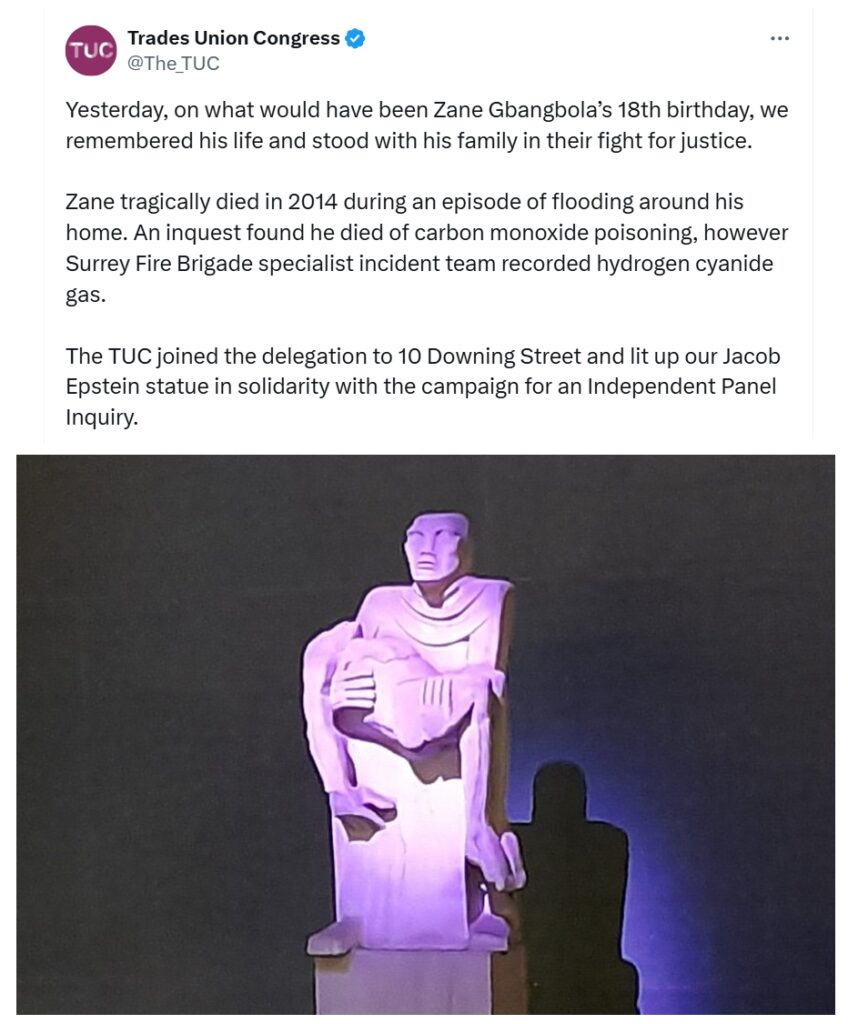
To mark its solidarity with the campaign, the TUC lit up its historic Jacob Epstein statue at Congress House in Great Russell Street.
September 2024
Green Party calls for ‘Zane’s Law’ to address ‘contamination crisis’
Green Party conference in Manchester has voted for a new law to protect people from contaminated land. It has been coined ‘Zane’s Law’ after 7-year-old Zane Gbangbola who died when hydrogen cyanide was carried by floodwater from a contaminated landfill site into his home in 2014. The legislation would force all Local Authorities to keep a regularly updated Register of Land that may be contaminated and the Environment Agency to hold a National Register of Contaminated Land.
Zane’s father Kye Gbangbola received a standing ovation from the conference in recognition of his tireless campaigning for the truth about Zane and the for transparency around toxic landfill sites.
Green peer Natalie Bennett, who proposed the successful motion, said:
“Current UK regulations on contaminated land pose a threat to human life and welfare. They are dangerously inadequate, especially given climate breakdown, rising sea levels, increased rainfall, and flooding. Zane’s Law proposes measures to address this crisis.
“It seeks to address this contamination crisis by aligning the UK with global best practice for the protection of communities from hazardous land. It would reinstate legislative provisions removed by the Conservative government from the 1990 Environment Protection Act and ensure the UK adheres to the Universal Right to a Healthy Environment, endorsed by the UN in July 2022.
“The protection of citizens must be a primary responsibility of government. As Greens we therefore urge Labour to add this important and long overdue law to their legislative programme and provide the necessary funds for Local Authorities to meet the new requirements.”
April 2024
- Stroud District Council agrees motion demanding action on land contamination risks
The motion was unanimously passed at the full council meeting on 25 April.
Zane’s father, Kye Gbangbola, attended the meeting. Thanking him, Green Councillor Beki Aldam, who moved the motion, said:
“No family should have to go through what Zane’s family have been through, and these measures, we hope, will be part of Zane’s legacy to ensure that the tragedies of the future never happen. As Zane once said, people think sustainability means looking after your garden, but it’s really about a bigger garden that belongs to everyone.”
Clr Aldam said she was “shocked” to learn that there are 1,700 potentially contaminated sites in Stroud District, some the result of the area’s long history of industrial activity, including the wool and textile industry and the manufacture of dyes.
One is in her own ward: a site in Brimscombe where waste of various kinds has been dumped, damaging the flora and fauna and contaminating a stream that flows into the River Frome.
In her speech to council, Cllr Aldam said councils have a legal duty to manage and monitor contaminated land, to prevent new contamination being caused, and to require clean-up by the responsible polluter. But there is not enough funding for them to do it effectively.
“We need the national government to step up and fund, resource and vocally support this vital work,” she said. “These sites have to be investigated and potential mitigation work has to be carried out to make them safe.” - National Educational Union pledges continuing support for justice for Zane
Watch the powerful video by NEU General Secretary Daniel Kebede:
March 2024
- Following Lewes District Council’s lead, two further councils vote in support of Zane’s Law on the same day, 28th March – Brighton & Hove City Council (motion proposed by Green Cllr Kerry Pickett) passed unanimously, and Adur Council (motion proposed by Green Cllr Gabe Crisp).
Read the reports in The Argus and from the BBC.
February 2024
- Lewes District Council vote unanimously in support of Zane’s Law, the first Local Authority in the UK to do so, 19 February 2024
Read the LDC motion here. - Campaign and petition for Zane’s Law launched
Please sign and share the petition here!
- MPs Call for Independent Panel Inquiry into the death of Zane Gbangbola
EDM (Early Day Motion) 350: tabled on 1 February 2024
Sponsors: Ian Byrne MP, Richard Burgon MP, Liz Saville Roberts MP, Caroline Lucas MP, Chris Stephens MP, Apsana Begum MP.
Further signatories: Marie Rimmer MP, Ian Lavery MP, Bell Ribeiro-Addy MP, Beth Winter MP, Jeremy Corbyn MP, Kim Johnson MP, John McDonnell MP, Zarah Sultana MP, Claudia Webbe MP, Neale Hanvey MP, Mick Whitley MP.
October 2022
- Zane’s parents accompanied by Matt Wrack, then General Secretary of the Fire Brigades Union (FBU), hand in a petition to No.10 Downing Street, signed by over 111,000 people, demanding an Independent Panel Inquiry into Zane’s death. Speakers at a rally, held atop the FBU Campaign Fire Engine, include Kye and Nicole (Zane’s parents) Matt Wrack, Natalie Bennett, Jeremy Corbyn, with messages of solidarity, including from Andy Burnham (Mayor of Manchester), a long-term supporter of the Truth About Zane Campaign.
November 2021
- Zane’s Law is launched at COP 26 by Baroness Natalie Bennett and Zane’s parents, Kye Gbangbola and Nicole Lawler, at a special ‘Peace and Justice Project’ event, hosted by Jeremy Corbyn.
Listen to the podcast: Natalie Bennett launches Zane’s Law at COP 26.
